

Two layers, one stack. Naive Managed Agents is the autonomous-company infrastructure — the harness, the managed runtime, sessions, budgets, tools. Naive blueprints are the layer on top: the templates a whole company is installed from, and the studio you run it in. These pages are the Managed Agents reference; the API, SDK and CLI still identify it as
vetta (api.vetta.sh, @usenaive-sdk/vetta, the vetta binary).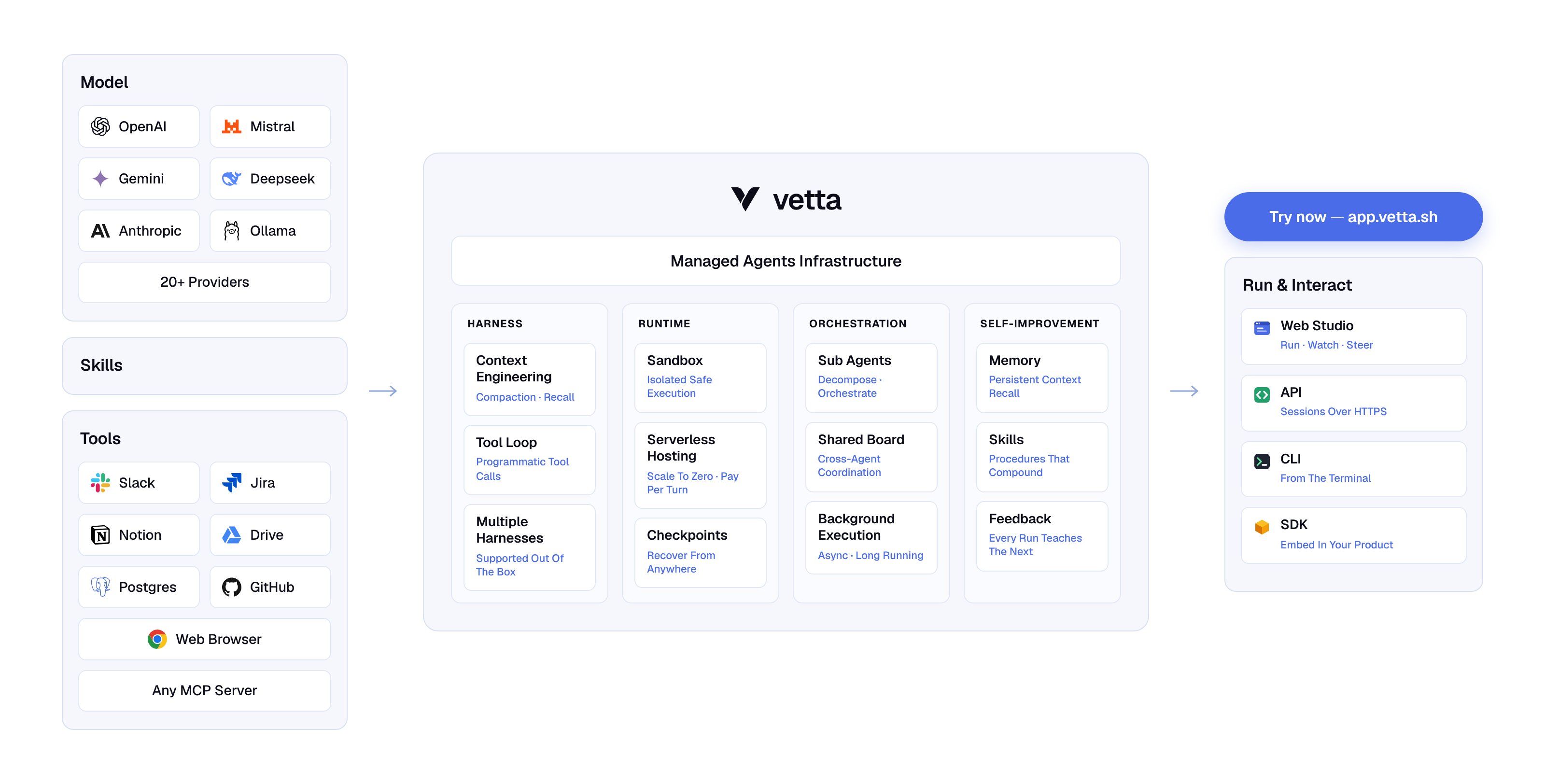
Create an agent, run a session
The pillars, as objects
Everything you touch maps to primitives you create and version — familiar on day one.Agent
A reusable, versioned config: model, harness, prompt, tools, skills, budget.
Session
One directly-controlled run of an agent — send input, stream output, interrupt, resume.
Events
A resumable stream of everything the agent does, keyed by sequence number.
Computer
A disposable sandbox with a filesystem, shell, and optional browser — paused when idle.
Skills
Persisted, versioned expertise loaded with progressive disclosure.
Files
Durable, organization-scoped storage for the artifacts a session produces.
How Naive Managed Agents earns the highest ROI per dollar
Four independent levers, all cutting dollars per finished task without cutting quality.Available today & what’s next
Available now: agents, sessions, the durable runtime, completion windows, budgets, the computer, skills, files, cron, webhooks, real-USD billing, identity (personas, domains, email, SMS, connections, the vault) — plus web search and fetch, image and video generation, the Messages-format model proxy, observability, structured outputs, audit logs, and teams — a coordinator with a version-pinned roster, delegation, and a shared board.Quickstart
Create an agent, run it, and read the meter in under five minutes.
How Managed Agents works
Harness, runtime, tools — what each layer is, and which one you pick.