TL;DR
- An animals eating channel posts generated clips of one healthy animal eating a big feast.
- It is a ready-made template that runs on naïve: an agent team makes each video, and you approve what posts.
- Every clip is fully generated, never real animal footage, and labelled as AI-generated.
- To start, sign up for a naïve account, then deploy the Animals Eating Channel template.
An animals eating video channel is a ready-made template that runs on naïve: an agent team generates clips of one healthy animal eating a feast.
There is no animal to film and no camera. Every clip is labelled AI-generated.
Step one is a naïve account. Then you deploy the template, and every video waits for your approval before it posts.
What is an animals eating video channel?
It is one ready-made company template, not a pile of tools you wire together. When you deploy the template, naïve sets up — in a single step — a small team of AI agents, a channel dashboard to manage the queue, your connected posting accounts, and the budgets those agents run under. The animal-feast version is a style of the faceless short-form channel — the same underlying setup, with the format pinned (a built-in set of instructions) on every agent so it already knows the look.
Each video follows the same recognisable shape:
- One healthy animal, such as a Doberman, as the single subject.
- A big raw-meat feast outdoors, generated with eating sounds so the crunch carries the clip.
- One consistent look, held steady by the reference screenshots that ship with the template.
Before you start
You do not need much, and that is the point. Still, three things make the first week go better:
- A subject. Pick the animal and the vibe — a Doberman tearing into a steak feast reads differently from a fox in a forest. A channel with a lane beats a channel that posts anything.
- A reference channel. One account whose look you like. The agents model the style on it; they do not copy its videos.
- A cadence you will actually approve at. One a day you review is worth more than ten a day you ignore.
Set it up in five moves
Setup is a short interview, not a configuration screen. Here is the whole shape before you touch it:
01
Sign up for naïve
Create a naïve account at app.usenaive.ai. The template and its agents run there.
02
Open the company
Start from the Animals Eating Channel. The animal-feast skill is already pinned, so the team knows the format on day zero.
03
Answer the questions
Your animal and angle, your cadence, and a reference channel to model the look on. That is the entire brief.
04
Agents produce
On your schedule, they research, generate each feast video, and hold one consistent look across every post.
05
You approve
Each finished video waits in a queue with its caption and AI label. Approving is the only way it posts.
1. Sign up for a naïve account
The channel runs on naïve, so start by creating an account at app.usenaive.ai.
2. Open the Animals Eating Channel
From your naïve account, start from the company template page and deploy the template. Because animal-feast is a style of the faceless short-form channel, the agent team arrives already knowing the format — you are not teaching it what a feast video is, you are pointing it at your version of one.
3. Answer the setup questions
The team asks you a short set of questions before it sets anything up:
- Subject — the animal and the angle your channel runs in, in a sentence.
- Cadence — how often you want to post.
- Reference — a channel or video whose look you want to model.
These answers are not thrown away after setup. They become the project context every agent reads at the start of every run, and you can edit them later. Swap the animal in week three and the next batch follows the new brief.
What's the subject and angle of your animals eating channel?
The agents read this before every run, so one tight lane beats a broad one.
- Big dogs, big feasts — a Doberman tearing into a raw-meat spread
- Wild predators — foxes and wolves eating in the forest
- Exotic animals — unexpected species at an outdoor feast
- Everything — mixed animals, no single subject
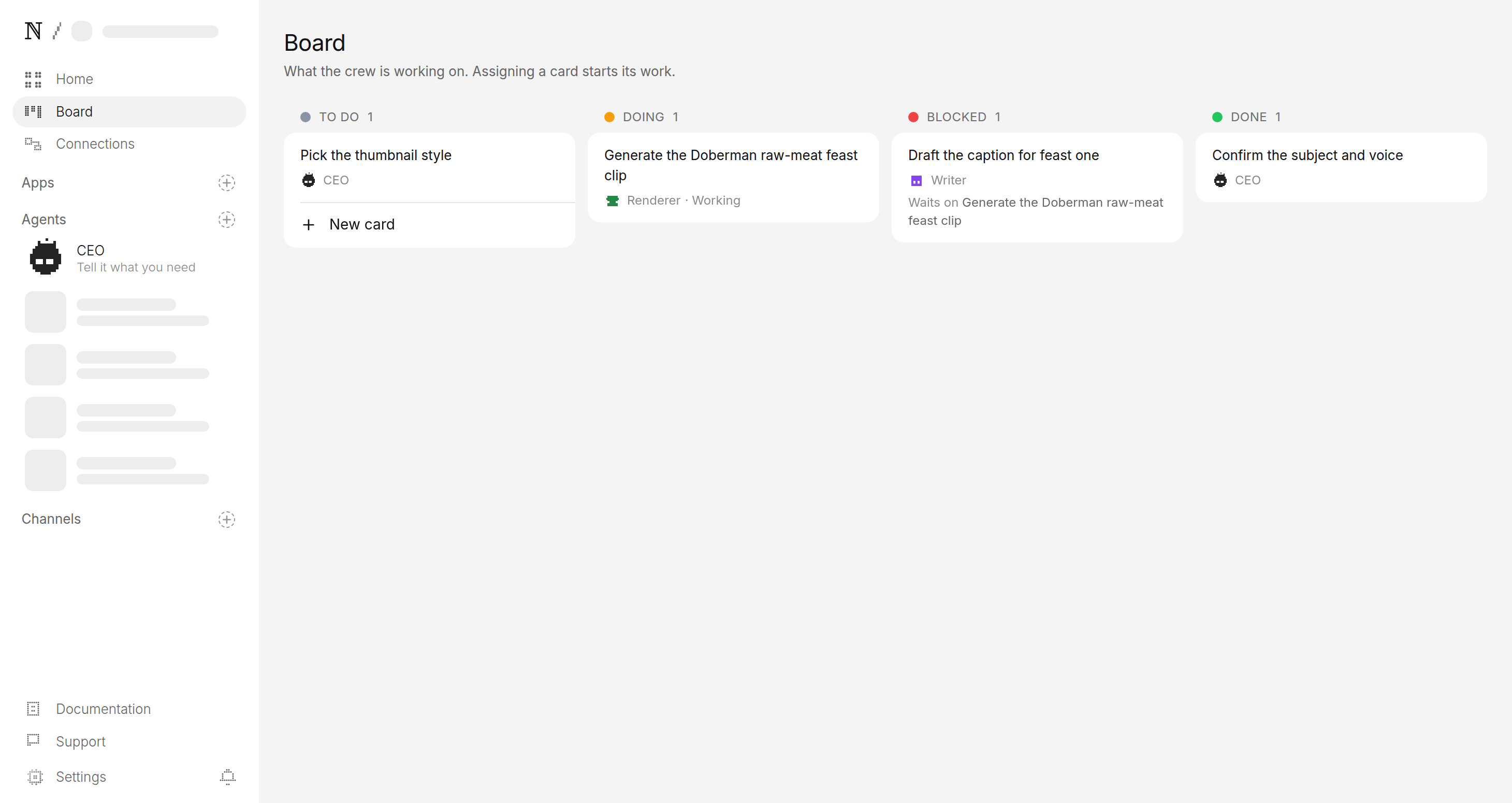
4. Let the team produce the first batch
On the schedule you set, the agents wake up and go to work. They do not run around the clock; they only run at the scheduled times you choose, so between those runs nothing is running and nothing is spending. When a scheduled run starts, the team:
- Researches which animal eating videos are doing well right now, so the briefs chase a real trend instead of a guess.
- Generates each video of one animal eating a big feast, with eating sounds, and a caption drafted against it.
- Holds the look using the reference screenshots that keep every post in the same consistent style.
If the queue is already ahead of you, it makes nothing. The backlog is treated as a signal to stop, not a number to grow.
5. Approve before anything posts
This is the step that matters most, so it is worth being precise about. Every finished video is filed as a pending post, not a published one. It lands in a review queue with everything attached:
- The video, ready to play, already carrying its AI-generated label.
- The caption, drafted in your channel's voice.
- Where and when it is queued to go.
You watch it, edit the caption if you want, and approve or hold. Approving is the only path onto TikTok, Reels, or Shorts — there is no setting that lets a video skip you.
Publisher wants to post to TikTok, Instagram and YouTube
- Caption
- He waited all day for this feast. 🍖 #animalseating #asmr #satisfying
- Goes out
- Tomorrow 4:22 PM ET
- Visibility
- Public
What are the specs for each platform?
The output is a single vertical file that fits every short-video surface, so you are not re-cutting for each app. The specs below are the same across all three destinations — only the caption framing changes:
| Destination | Duration | Aspect ratio | Resolution | Caption & hashtags |
|---|---|---|---|---|
| TikTok (For You) | 15–30s | 9:16 vertical | 1080×1920 | Feast in the first second; ~3–5 tags such as #animalseating #asmr #satisfying |
| Instagram Reels | 15–30s | 9:16 vertical | 1080×1920 | Same file; caption tuned for Reels, ~3–5 hashtags |
| YouTube Shorts | up to 60s | 9:16 vertical | 1080×1920 | Same file; put the animal and feast in the title, 2–3 hashtags |
This format lives on sound: the crunch and chewing carry the clip, so the eating audio is baked into the generated video rather than added later. Post the same video to all three, or pick the ones your channel uses at setup. Either way, each post still parks in approval first.
What keeps the channel in your control?
Two guarantees sit under everything the agents do, and both are enforced by the platform itself rather than left to the agents to honour on their own:
- A budget it cannot raise. You set a daily cap per agent and a cap per task. Every generation is priced before it runs, and a batch that would blow the cap stops instead of spending. The channel cannot surprise you on cost. As an illustration, teams typically set a daily cap of around $10–20 per agent, and a single generated feast clip might cost a few dollars to produce — so a realistic first week runs on a small, predictable budget.
- A queue it cannot skip. The agents do the week's work — research, generated videos, captions — but your posting account itself is yours alone. The pending-approval queue is the only way anything reaches it.
What does your first week look like?
A realistic first week looks like this. Sign up for naïve, deploy the template, and answer the setup questions. Let the first batch build on the next scheduled run. In the morning, open the queue, watch a handful of videos, and approve the two or three that are genuinely good. Repeat. By the end of the week you will have a feel for which animals and feasts land, and you can tune the setup answers to chase them.
If you want to run a different generated format on the same platform, the AI history channel colorizes major events as if filmed today, and the faceless AI UFC channel generates original fights end to end. You can also browse the full faceless video channel company to name any niche at setup. The approval and budget rules in this guide are identical across all of them.
FAQ
- Is the footage generated or clipped from real videos?
- It is fully generated. The channel never clips, downloads, or re-edits real animal footage — each video is produced from the reference screenshots in the template, with the eating sounds generated in. Every clip is labelled as AI-generated.
- Do I need a real animal or a camera to run this channel?
- No. Every video is generated from the reference screenshots that come with the template, so there is nothing to film and no animal to source. The channel runs entirely on generated clips of one healthy animal eating a feast.
- Is this cruelty-free, and how do viewers know it is AI?
- Yes. The videos only ever show one healthy animal eating a big feast outdoors, never an animal in distress, and every clip is labelled as AI-generated. The approval step is where you confirm each video before it posts, so you stay on the right side of each platform's rules.
- How many videos can it make per day?
- As many as the cadence you set and the budget you give it. If the review queue is already ahead of you, the agents make nothing rather than piling up more — the backlog is a signal, not a target.
- What does it cost to run?
- You set a daily cap per agent and a cap per task at setup, and the platform prices every generation before it runs. A batch that would exceed the cap stops instead of spending, so the channel cannot surprise you on cost.