- ›
OAuth connections cover the head of the market (Gmail, Slack, GitHub). The long tail is worse: niche SaaS that only issue a raw API key, and legacy portals with no API at all— only a login form. An agent that operates them has to hold real secrets, and that is exactly what breaks a naive build. - ›Naïve ships the hard part as primitives: a per-user Credential Vault (envelope-encrypted with a managed KMS), autonomous browser signup/login that vaults credentials the model never sees, Account Kits that gate both at execution time, and human-in-the-loop approvals.
- ›
Two credential surfaces, one custody layer. Revealable entries (kind api_key) are secrets the agent's own code reveals at execution time to call a SaaS. Locked entries are write-only: stored once, used server-side, and never revealable back— reveal returns forbidden. - ›
browser.signup autonomously creates an account under the user's identity with a strong generated password, stores it in the vault, and never returns it to the agent or the model. browser.login re-authenticates from the vault later— the password never crosses the agent/LLM boundary. - ›Enforcement is server-side and per tenant. A kit with vault disabled makes vault.reveal throw forbidden (primitive_disabled_by_kit); an expired session token 404s on reveal; autonomous signup is approval-gated (202 pending_approval); and per-tenant KMS EncryptionContext means one customer's wrapped key can never decrypt another's row.
- ›You write the operator logic. Naïve enforces who the agent is, which secrets it may reveal, which it may only use, and what needs a human first.
Most agent demos operate the head of the integration market — Gmail, Slack, GitHub — where a clean OAuth flow exists and a platform like Naïve's connections hands you authenticated access. That is the easy 20%.
The long tail is where real back-office work lives, and it is nastier:
- Niche SaaS that only issue a raw API key. No OAuth, no token refresh — just a
key_...string the user pasted in, or that your agent generated during onboarding. - Legacy portals with no API at all. An insurer's broker portal, a utility billing site, a county records system, an old vendor dashboard. The only interface is a login form.
An agent that operates these has to hold real secrets — and that is exactly the part a naive build gets wrong. The moment you have more than one customer, you are on the hook for:
- Encrypting each customer's API keys and passwords, per customer, at rest.
- Scoping decryption so one tenant's agent is not intended to decrypt another tenant's secret.
- Holding some secrets write-only — the agent must be able to act with a password without ever being able to read it back, so a prompt-injected instruction can't exfiltrate it.
That plumbing is the product. It is also exactly what Naïve ships as primitives — the per-user Credential Vault and the browser primitive that consumes it. This is a developer tutorial: every code block runs against the current @usenaive-sdk/server, with signatures pulled straight from the docs.
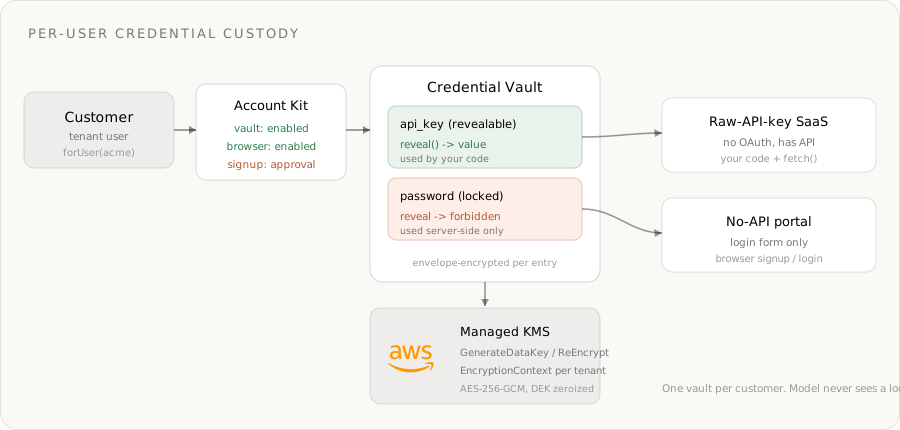
What we're building
- A multi-tenant backend where each customer gets an operator agent that works the tools OAuth can't reach.
- Surface A — raw-API-key SaaS. The agent stores each customer's provider key in the vault and reveals it at execution time to make the call. Keys rotate on a KMS cadence; short-lived tokens carry an expiry.
- Surface B — no-API portals. The agent autonomously signs up for an account under the customer's identity; the password is generated and vaulted write-only. Later it drives a real cloud browser to log in, navigate, and extract — without the password ever reaching the model.
- The moat lever is custody:
lockedentries the agent uses but can never read back, per-tenant KMS isolation, expiring session credentials, and execution-time kit gating plus signup approval.
The primitives in play, all from the docs:
| Primitive | Role in the operator | Docs |
|---|---|---|
| Users | One tenant user per customer — the isolation boundary | naive.users |
| Account Kits | The plan: which primitives are enabled, plus approval rules | naive.accountKits |
| Vault | Per-user encrypted secret custody (revealable + locked) | forUser(id).vault |
| Browser | Cloud browser + autonomous signup/login that vaults credentials | forUser(id).browser |
| LLM | OpenRouter-backed planning across 300+ models | forUser(id).llm |
| Approvals | Human-in-the-loop on autonomous account creation | forUser(id).approvals |
| Logs | Per-customer audit trail of every secret access | forUser(id).logs |
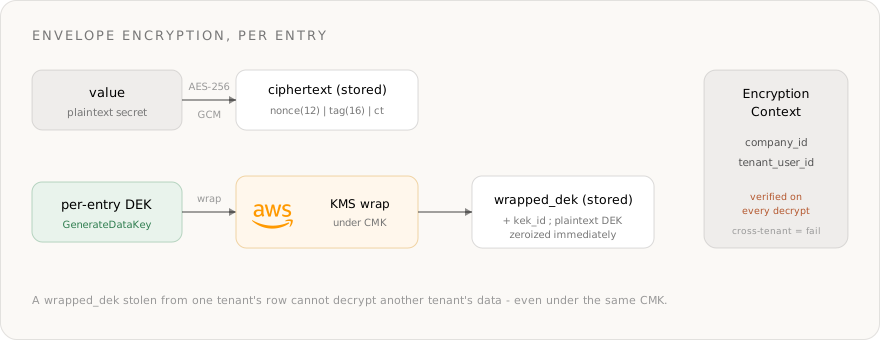
Underneath the vault sits envelope encryption with a managed KMS — the piece you never want to hand-roll:
Step 0: Install and authenticate
You need a Naïve workspace key (nv_sk_...) from the dashboard → Settings → API keys. The SDK is server-only — keys are server secrets, never shipped to the browser.
npm install @usenaive-sdk/serverimport { Naive, NaiveError, isPendingApproval } from "@usenaive-sdk/server";
const naive = new Naive({ apiKey: process.env.NAIVE_API_KEY! });Two surfaces matter, and the split is the whole design:
naive.*(the root client) acts on your default tenant user and exposes the control plane (naive.users,naive.accountKits).naive.forUser(id).*returns the data plane (vault,browser,llm,approvals,logs) bound to one customer.
Read naive.forUser(customerId) as: "do this, as this customer, under this customer's plan, against this customer's secrets." Acme's agent is naive.forUser(acmeId); it has no path to Globex's vault.
Step 1: The two credential surfaces
The vault stores per-user secrets that aren't third-party OAuth grants — a SaaS API key, a session cookie, a KYC reference (docs). There are two kinds of entry, and the difference is the moat.
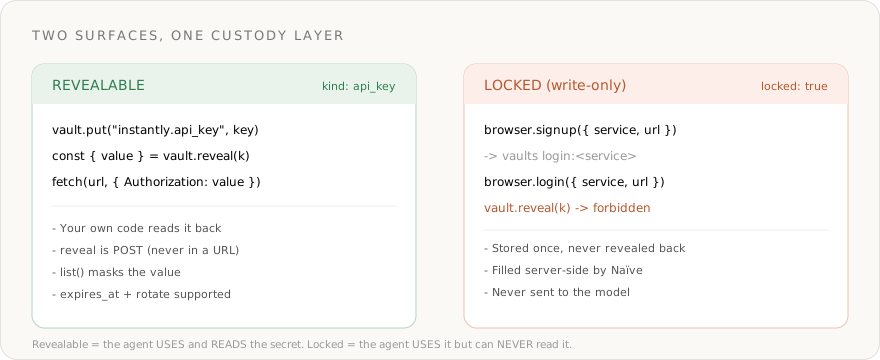
- Revealable entries. Stored with a
kindlikeapi_key. Your own code callsvault.reveal(key)to read the value back at execution time and put it in anAuthorizationheader. Reveal is a POST, so the secret travels in the response body — never in a URL — andlist()masks values. - Locked entries. Stored with
locked: true. They can be used indirectly by Naïve's primitives but can never be revealed back —vault.revealreturns aNaiveErrorwith codeforbidden. This is how a portal password is held: the browser primitive logs in with it server-side, but nothing in your stack (or the model's context) can read the raw value.
The put parameters, straight from the docs:
| Param | Type | Default | Description |
|---|---|---|---|
value | string | — | The secret to encrypt and store |
kind | string | note | api_key, password, cookie, token, note, reference |
locked | boolean | false | If true, the entry can be stored but never revealed back |
expiresAt | string | — | ISO timestamp (SDK); stored as expires_at in the API. Excluded from list and 404 on reveal once expired |
metadata | object | — | Arbitrary JSON attached to the entry |
Step 2: Provision a customer and its plan
An Account Kit is a reusable policy template. The vault and browser are Tools primitives, so the kit decides whether a customer's agent can use them at all — and whether autonomous account creation needs a human.
// The operator plan: custody + browser on, autonomous signup gated for a human.
const operatorKit = await naive.accountKits.create({
  name: "Operator",
  primitives_config: {
    vault: { enabled: true },
    browser: { enabled: true, requiresApproval: true }, // signup freezes for approval
    llm: { enabled: true },
  },
});
Each customer is a tenant user. Tenant users never sign into Naïve — you manage them entirely through the SDK. Point their email at a provisioned inbox so autonomous signups can receive verification mail.
const acme = await naive.users.create({
  external_id: "customer_acme",       // your stable id for the customer
  email: "ops@acme.example",          // used as the account email on signups
  label: "Acme Inc",
  account_kit_id: operatorKit.id,
});

const acmeClient = naive.forUser(acme.id);
Step 3: Surface A — a raw-API-key SaaS
Some SaaS never added OAuth; they hand the user a key string. Store it once, per customer, then reveal it only at execution time.
// Onboarding: the customer pasted their key for a cold-email SaaS.
await acmeClient.vault.put("instantly.api_key", "key_live_xyz", {
  kind: "api_key",
  metadata: { provider: "instantly", scope: "campaigns" },
});
When the agent needs to call that SaaS, it reveals the key at the moment of the call — the value lives in memory only for the request:
const { value: apiKey } = await acmeClient.vault.reveal("instantly.api_key");

const res = await fetch("https://api.instantly.ai/api/v2/campaigns", {
  headers: { Authorization: `Bearer ${apiKey}` },
});
Two custody features you get for free here:
- Expiring tokens. For a short-lived session token, set
expiresAtonvault.put(). Once it passes, the entry drops out oflist()andrevealreturnsnot_found— the agent's cue to re-mint it, with no stale secret lingering.
await acmeClient.vault.put("acme_portal.session_token", tok, {
  kind: "token",
  expiresAt: new Date(Date.now() + 30 * 60_000).toISOString(), // 30 minutes
});- Rotation. Re-wrap the data key under the current CMK version on a schedule — cheap, and the value ciphertext is unchanged. Pass
{ regenerateDek: true }for a full re-encryption.
await acmeClient.vault.rotate("instantly.api_key");                     // KMS re-wrap
await acmeClient.vault.rotate("instantly.api_key", { regenerateDek: true }); // full
To rotate the secret value itself (you generated a fresh key on the SaaS), just put the new value under the same key — put is idempotent on the key.
Step 4: Surface B — a portal with no API at all
Now the hard case: a site with no API and no OAuth, only a login form. The browser primitive gives the customer a real cloud browser and two autonomous actions — signup and login — that handle account creation and re-authentication end to end, vaulting the credential for you.
Site terms. Autonomous signup and login must comply with each site's terms of service and robots rules. Naïve provides the browser runtime; you decide which domains are allowed and which flows require human approval.
signup opens a scoped, write-enabled session, fills the registration form with the customer's identity and a strong generated password, submits, and stores { email, password } in the vault under login:<service>. The password is filled server-side via variable substitution and is never returned to the agent or sent to the model. Because it creates a real account under the customer's identity, it is approval-gated — and our kit turned that on.
const res = await acmeClient.browser.signup({
  service: "vendor-portal.example",
  url: "https://vendor-portal.example/signup",
});

if (isPendingApproval(res)) {
  // HTTP 202 — frozen until a human approves (res.approval_id)
  await acmeClient.approvals.approve(res.approval_id);
  // On approval the signup runs; the generated password is now vaulted write-only.
}
Later — when the browser session has expired and the agent needs the portal again — login reads the stored credential from the vault and signs back in, again without the password crossing the agent/LLM boundary:
await acmeClient.browser.login({
  service: "vendor-portal.example",
  url: "https://vendor-portal.example/login",
});
From there the agent drives a real session step by step. Sessions are scoped to an allowlist of domains (default-deny), and destructive/submit actions require allow_writes:
const s = await acmeClient.browser.createSession({
  allowed_domains: ["vendor-portal.example"],
  allow_writes: true,
});

await acmeClient.browser.navigate(s.session_id, "https://vendor-portal.example/invoices");
const invoices = await acmeClient.browser.extract(
  s.session_id,
  "the list of invoice numbers, dates, and amounts due",
);
await acmeClient.browser.act(s.session_id, "download the most recent invoice PDF");

await acmeClient.browser.closeSession(s.session_id); // always close — idle sessions bill a time floor
Two rules the docs make explicit, and they matter for safety:
- Never put a secret in an
act/extractinstruction. The autonomous signup/login flow handles credentials server-side; instructions are sent to the model, credentials are not. - For SSO, 2FA, or CAPTCHAs, a human completes the login once in the dashboard live view and saves it as a reusable, encrypted context. Naïve stores only an opaque pointer — never the cookies. Later sessions reopen already-logged-in, gated by a human-created grant (default-deny): the agent can use a saved login but can never create the grant or revoke it.
Step 5: The moat — a secret the agent can use but cannot read
Here is the part you can't get from "a secrets manager plus a headless browser." The password the agent just used to log into the portal is locked in the vault. Try to read it back:
try {
  await acmeClient.vault.reveal("login:vendor-portal.example");
} catch (err) {
  if (err instanceof NaiveError && err.code === "forbidden") {
    // Locked entries can be used, never revealed. The raw password never leaves KMS.
    console.log(err.hint);
  }
}
The other two walls are just as hard, and all three run inside Naïve, at execution time — not as a check you remembered to write:
- Expired secret →
not_found. A session token past itsexpiresAt404s on reveal and is excluded fromlist(). There is no window where a stale secret leaks.
try {
  await acmeClient.vault.reveal("acme_portal.session_token"); // after expiry
} catch (err) {
  if (err instanceof NaiveError && err.code === "not_found") {
    // Re-mint the token; nothing stale is served.
  }
}- Kit disables the primitive →
forbidden. Custody itself is a plan feature. Put a customer on a kit withvault: { enabled: false }and every vault call fails server-side, before it ever touches KMS:
const readOnlyKit = await naive.accountKits.create({
  name: "Suspended",
  primitives_config: { vault: { enabled: false }, browser: { enabled: false } },
});
await naive.accountKits.assignUser(readOnlyKit.id, acme.id);

try {
  await acmeClient.vault.reveal("instantly.api_key");
} catch (err) {
  if (err instanceof NaiveError && err.code === "forbidden") {
    console.log(err.hint); // "primitive_disabled_by_kit"
  }
}- Autonomous account creation →
202 pending_approval. As in Step 4,browser.signupfreezes for a human when the kit gates it — it does not throw (errors). Granting the agent the power to create a real account under the customer's identity is the moment a person signs off.
So the enforcement mechanisms compose:
lockedcustody → the agent acts with a secret it can never exfiltrate. Hard wall, no human, instant.expiresAt→ stale secrets 404 instead of leaking.- Kit gate → custody is a plan feature toggled with one config edit, applied to every customer on that tier on the next call.
- Approval gate → high-consequence account creation freezes until a human approves.
Step 6: Why the isolation actually holds
Custody claims are only worth the crypto behind them. Naïve's vault encryption is envelope encryption with a managed KMS:
- A per-entry data key (DEK) is generated by
KMS GenerateDataKey. - The value is encrypted locally with AES-256-GCM (
nonce(12) || tag(16) || ciphertext). - KMS returns the DEK already wrapped by the shared customer-managed key (CMK). Naïve stores the ciphertext, the
wrapped_dek, and thekek_id, and zeroizes the plaintext DEK immediately.
The line that makes multi-tenant safe:
- Every KMS call passes
EncryptionContext = { company_id, tenant_user_id }, and KMS verifies it on decrypt. Awrapped_dekstolen from one tenant's row cannot decrypt another tenant's data — even under the same CMK. The IAM policy scopes KMS actions to that one key and requires the tenant context, so a request that omits it is rejected before it reaches KMS.
That is the difference between "we encrypt secrets" and "one customer's agent is cryptographically unable to read another customer's secret" — and it is enforced by the key management layer, not your code.
Step 7: The per-customer audit trail
Every primitive write and secret access emits an activity event scoped to the tenant user. Pull one customer's history — there's no way to accidentally read another tenant's events (docs):
const { events } = await acmeClient.logs.query({ limit: 50 });
// vault.put / vault.reveal / browser.login events for Acme only — who accessed
// which secret, when, and the result — useful for internal audits, not a substitute for a formal SOC 2 program on its own.
Filter by action (e.g. vault.put) to answer "every time this customer's key was read this month" without building a logging pipeline.
What you didn't build
Count the infrastructure you skipped — the part that is normally the whole product:
- Per-customer secret encryption with a managed KMS, per-entry data keys, and zeroized plaintext. (Vault + Vault encryption.)
- Write-only custody so the agent can act with a password it can never read back. (
lockedentries.) - Cryptographic tenant isolation so Acme's agent can never decrypt Globex's secret. (Per-tenant KMS
EncryptionContext.) - Autonomous account creation and re-login on sites with no API, with the password never reaching the model. (Browser signup/login.)
- A human-in-the-loop gate on creating real accounts, and human-only grants for SSO/2FA saved logins. (Approvals + saved-login grants.)
- A per-customer audit log of every secret access. (Logs.)
You wrote the operator logic. Naïve enforced who the agent is, which secrets it may reveal, which it may only use, and what needs a human first — at execution time, server-side, per tenant.
Ship it
- Model your customers as tenant users and give them an Operator Account Kit with
vaultandbrowserenabled. - Store raw-API-key SaaS secrets as revealable entries and reveal them at execution time; carry an
expiresAton short-lived tokens androtateon a cadence. - Let the browser primitive autonomously sign up and log in on no-API portals — the password is vaulted
locked, and even you can't read it back. - Trust the API, not your prompt, to stop a
revealthe plan doesn't allow. - For SMS-gated logins, pair browser with inbound 2FA on /phone.
Start from the Vault guide, the Vault encryption architecture, and the Browser guide. Get a workspace key in the Naïve dashboard and build the operator for the 80% of tools OAuth never reached.
Why can't I just build this with a secrets manager plus a headless browser?+
What is the difference between a revealable and a locked vault entry?+
How does the agent log into a site that has no API and no OAuth?+
What does execution-time permission enforcement mean for the vault?+
How are the secrets actually encrypted?+
How do I rotate a stored credential?+
Do my customers ever sign into Naïve?+
Building the autonomous company infrastructure.
Secrets management for AI agents means letting an agent use a credential without exposing it to the model. Here's the per-tenant vaulting pattern that fixes it.
How to store API keys for AI agents safely: keep the key out of the prompt, encrypt it per user, and let the agent use it server-side. A step-by-step guide.
The vault primitive: per-user encrypted storage for the secrets your agents hold — API keys, cookies, tokens — envelope-encrypted with a managed KMS.
Browser sessions your agents drive — navigate, act, extract — plus autonomous signup and login that vault credentials, scoped per user and watchable live.