> ## Documentation Index
> Fetch the complete documentation index at: https://vetta.sh/docs/llms.txt
> Use this file to discover all available pages before exploring further.
# Vetta
> The most efficient managed agent for long-horizon work. The highest intelligence per dollar, by design.
export const Levers = ({items, cols}) => ;
**Vetta is a managed agent platform**: you define an [agent](/docs/capabilities/agent) — model, prompt, tools, skills, budget — and run it as [sessions](/docs/concepts/sessions) that work for hours, pause at storage cost, and finish without a person in the loop. You pay per finished task, in real dollars, priced before each call runs.
**Two names, one stack.** Vetta is the autonomous-company infrastructure — the harness, the managed runtime, sessions, budgets, tools. **Naive** is the layer on top: the blueprints and templates a whole company is installed from, and the [studio](https://app.usenaive.ai) you run it in. These pages are the Vetta reference, which is why every page below says Vetta. → [Naive and Vetta](/docs/naive-and-vetta)
Everything is built around one number: **the most intelligence per dollar spent** — the same model on different stacks varies several-fold in cost per completed task ([benchmarks](https://usenaive.ai/benchmarks)).
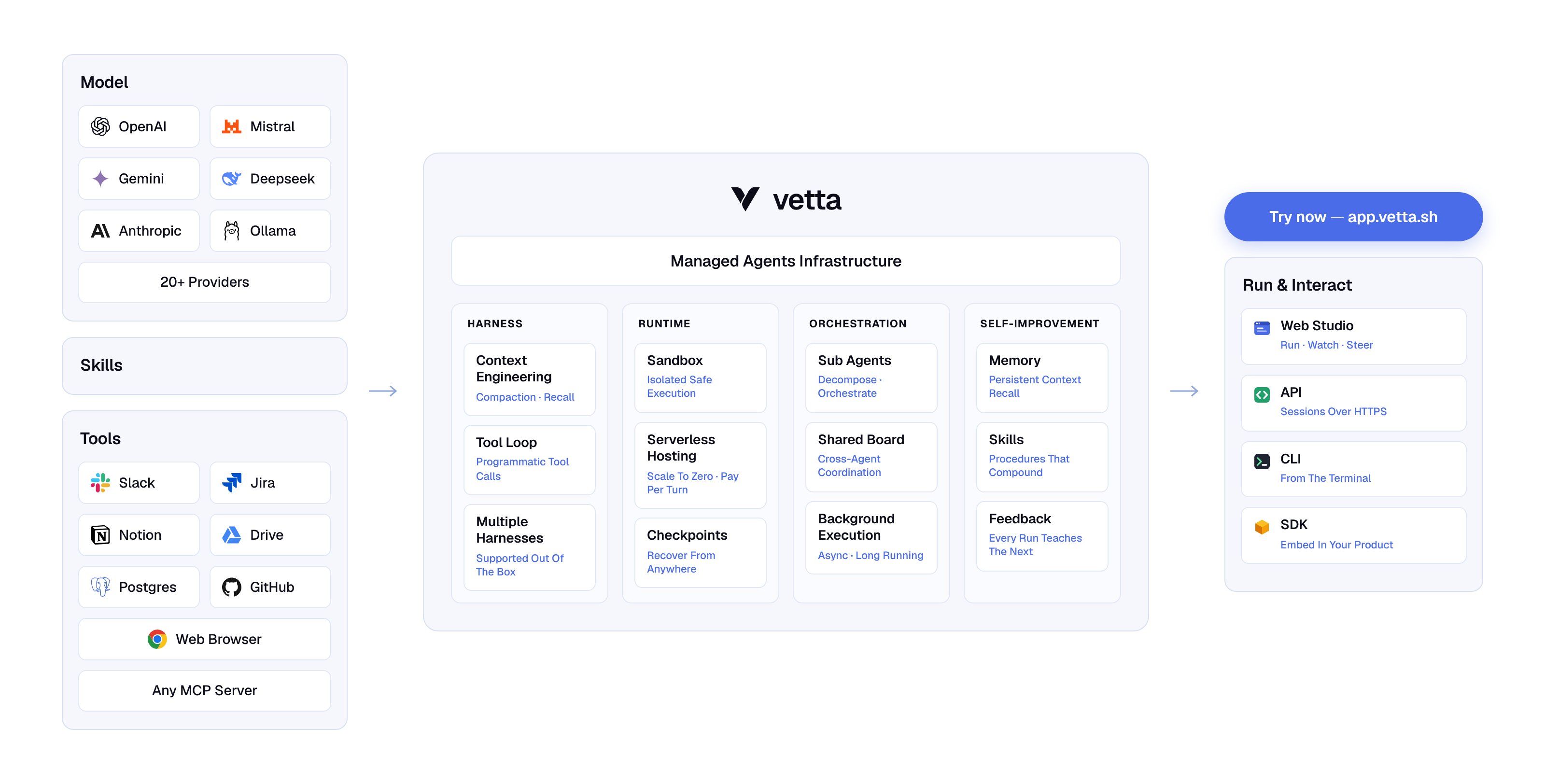 Any model, your skills, and your tools go in; Vetta's runtime does the work; and you run and interact through the [Web Studio](https://app.usenaive.ai), the [API](/docs/api/overview), the [CLI](/docs/cli/overview), or the [SDK](/docs/sdk/typescript).
## Create an agent, run a session
```typescript TypeScript theme={"system"}
import { randomUUID } from "node:crypto";
import { createClient } from "@usenaive-sdk/vetta";
const vetta = createClient({
baseUrl: "https://api.vetta.sh",
apiKey: process.env.VETTA_API_KEY!,
fetch: globalThis.fetch,
idempotencyKey: () => randomUUID(),
});
const agent = await vetta.agents.create({
name: "triage",
model: "zai-org/GLM-5.2-FP8",
system: "You are a concise triage agent.",
budget: { cap_micro_usd: 50_000_000, max_task_micro_usd: 5_000_000, period: "month" },
});
const session = await vetta.sessions.create({
agent_id: agent.id,
message: "Summarize what changed in main overnight.",
});
for await (const event of vetta.stream(session.id)) {
console.log(event.type);
}
```
```bash CLI theme={"system"}
npm i -g @usenaive-sdk/vetta-cli && vetta login --api-key sk_...
AGENT=$(vetta agent create --name triage --model zai-org/GLM-5.2-FP8 \
--budget-usd 50 --max-task-usd 5 --budget-period month \
--system "You are a concise triage agent." | jq -r .id)
SID=$(vetta session create --agent "$AGENT" \
--message "Summarize what changed in main overnight." | jq -r .id)
vetta session stream --session "$SID"
```
## The pillars, as objects
Everything you touch maps to primitives you create and version — familiar on day one.
A reusable, versioned config: model, harness, prompt, tools, skills, budget.
One directly-controlled run of an agent — send input, stream output, interrupt, resume.
A resumable stream of everything the agent does, keyed by sequence number.
A disposable sandbox with a filesystem, shell, and optional browser — paused when idle.
Persisted, versioned expertise loaded with progressive disclosure.
Durable, organization-scoped storage for the artifacts a session produces.
## How Vetta earns the highest ROI per dollar
Four independent levers, all cutting dollars per finished task without cutting quality.
## Available today & what's next
Available now: agents, sessions, the durable runtime, completion windows, budgets, the computer, skills, files, cron, webhooks, real-USD billing, [identity](/docs/capabilities/identity) (personas, domains, email, SMS, connections, the vault) — plus [web search and fetch, image and video generation](/docs/capabilities/tools#built-in-tools), the [Messages-format model proxy](/docs/api/proxy), [observability](/docs/capabilities/observability), [structured outputs](/docs/capabilities/structured-outputs), [audit logs](/docs/api/audit-logs), and [teams](/docs/capabilities/team) — a coordinator with a version-pinned roster, delegation, and a shared board.
Create an agent, run it, and read the meter in under five minutes.
Harness, runtime, tools — what each layer is, and which one you pick.
Any model, your skills, and your tools go in; Vetta's runtime does the work; and you run and interact through the [Web Studio](https://app.usenaive.ai), the [API](/docs/api/overview), the [CLI](/docs/cli/overview), or the [SDK](/docs/sdk/typescript).
## Create an agent, run a session
```typescript TypeScript theme={"system"}
import { randomUUID } from "node:crypto";
import { createClient } from "@usenaive-sdk/vetta";
const vetta = createClient({
baseUrl: "https://api.vetta.sh",
apiKey: process.env.VETTA_API_KEY!,
fetch: globalThis.fetch,
idempotencyKey: () => randomUUID(),
});
const agent = await vetta.agents.create({
name: "triage",
model: "zai-org/GLM-5.2-FP8",
system: "You are a concise triage agent.",
budget: { cap_micro_usd: 50_000_000, max_task_micro_usd: 5_000_000, period: "month" },
});
const session = await vetta.sessions.create({
agent_id: agent.id,
message: "Summarize what changed in main overnight.",
});
for await (const event of vetta.stream(session.id)) {
console.log(event.type);
}
```
```bash CLI theme={"system"}
npm i -g @usenaive-sdk/vetta-cli && vetta login --api-key sk_...
AGENT=$(vetta agent create --name triage --model zai-org/GLM-5.2-FP8 \
--budget-usd 50 --max-task-usd 5 --budget-period month \
--system "You are a concise triage agent." | jq -r .id)
SID=$(vetta session create --agent "$AGENT" \
--message "Summarize what changed in main overnight." | jq -r .id)
vetta session stream --session "$SID"
```
## The pillars, as objects
Everything you touch maps to primitives you create and version — familiar on day one.
A reusable, versioned config: model, harness, prompt, tools, skills, budget.
One directly-controlled run of an agent — send input, stream output, interrupt, resume.
A resumable stream of everything the agent does, keyed by sequence number.
A disposable sandbox with a filesystem, shell, and optional browser — paused when idle.
Persisted, versioned expertise loaded with progressive disclosure.
Durable, organization-scoped storage for the artifacts a session produces.
## How Vetta earns the highest ROI per dollar
Four independent levers, all cutting dollars per finished task without cutting quality.
## Available today & what's next
Available now: agents, sessions, the durable runtime, completion windows, budgets, the computer, skills, files, cron, webhooks, real-USD billing, [identity](/docs/capabilities/identity) (personas, domains, email, SMS, connections, the vault) — plus [web search and fetch, image and video generation](/docs/capabilities/tools#built-in-tools), the [Messages-format model proxy](/docs/api/proxy), [observability](/docs/capabilities/observability), [structured outputs](/docs/capabilities/structured-outputs), [audit logs](/docs/api/audit-logs), and [teams](/docs/capabilities/team) — a coordinator with a version-pinned roster, delegation, and a shared board.
Create an agent, run it, and read the meter in under five minutes.
Harness, runtime, tools — what each layer is, and which one you pick.